
Saint Maria Soledad
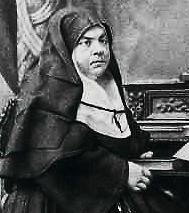
Mother Soledad Torres Acosta was a woman who was completely open to the action of the Holy Spirit. She knew how to see the hand of God in everything that happened around her. She let herself be seduced by His loving and irresistible call that invited her to follow Him. She welcomed Christ into her heart, and her life was transformed into a gift for others. In humility and with God as her sole support, she even dared to undertake a great work in the Church: The Institute of the Servants of Mary.
Saint Maria Soledad was born on December 2, 1826, in Madrid,Spain. She was the second child of Francisco Torres and Antonia Acosta. She was baptized two days later and was given the name Antonia Bibiana Manuela.
Her childhood and youth passed by in the simplicity of daily life like any other young girl of her time; however, her love for the Blessed Virgin Mary and for prayer already stood out in her. When she was 25 years old, she heard the Lord’s call and asked to be admitted into the new Institute of the Servants of Mary that Father Michael Martinez, the parish priest of the neighborhood of Chamberí, had set out to begin for the purpose of caring for the sick in their own homes. The foundation took place on August 15, 1851. Manuela, who from then on would be called Sister Maria Soledad, would be the seventh of the founding group.
This is how Mother Soledad began her long journey through inspirations and darkness as she placed herself at the service of the poorest of the poor–the sick–seeing in them Christ Himself. With the total gift of herself, she went about showering the most exquisite and diligent charity upon the sick and poor. With profound humility and her great capacity to love, she understood the richness that the poor and sick possessed: they were nothing less than Christ Himself, the Divine Patient. It was Him for whom she kept vigil at night. She would look at Him, talk to Him, love Him and cure His wounds and kiss them… and the encounter was transformed into trust, hope and salvation. In this way she collaborated in the building up of the Kingdom of God.
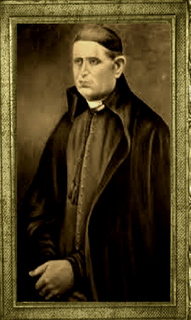 When Father Michael departed for the missions, she took charge of the Congregation, trusting in Divine Providence, and became the Foundress and Superior General of the Servants of Mary.
Mother Soledad did everything possible to provide for her Daughters’ spiritual well-being; her entire person reflected the gratuitousness and goodness of God. Her meek and humble heart was empty of herself and open to all; there were no limits of any kind for she knew that she belonged exclusively to God, and she gave her life as a free gift without receiving anything in return.
She solved everything with the logic of love based on humility, charity and gratitude. Because she lived poverty to the extreme and because she was profoundly humble, she acquired the liberty of spirit to be equable and magnanimous toward all, making herself the smallest and least of all.
Her secret was simple: Seek the will of God always and in everything
- in her many hours of prayer,
- in her personal encounter with God’s providence,
- in her friendship with Christ in the Holy Spirit
Her life revolved around the Lord’s presence in the Eucharist. Her nourishment were the Sacraments, especially the Eucharist, from whom she received the strength necessary to endure life’s hardships with patience and serenity in order to guide the Congregation with faith and unlimited trust in God. From the Eucharist, Mother Soledad received the grace to give herself without reserve to her work as can be seen in her Letter 89: “May the Lord grant us His holy peace and patience so that with these two shields, we may carry the holy cross that Our Lord in His mercy has destined for us.”
Her goal was clear: to be transformed into another Christ. From the very beginning, a clear sign of this transformation was her love for all, especially the most abandoned of society: those with contagious diseases. “The poor are my brothers”, she would say. She was so generous in sharing the little she had that all who came to her were surprised by this small woman with such a great soul. By her presence or her smile or by giving away a piece of bread, she revealed that God dwelled within her.
Mother Soledad showed us that the most wonderful gift from God is to be able to be fully identified with Christ who was obedient unto death on the cross. She experienced the emptiness, the loneliness and the abandonment of many, but never did she lack trust in Him who can do all things. She knew that the Cross of Christ is the source of strength and joy and that there are crosses that renew the life of the Church. She would exclaim, “May I know how to suffer”. “Give me light and grace to be able to suffer and endure more for You” (Letter 75). For her Daughters she prayed for “the grace to follow Him unto Calvary and to die crucified for love of Him” (Letter 75).
Mother Soledad took upon herself the suffering of the sick, of all of her Daughters, of the Church and of the entire world. She completed in her own body what was lacking in the passion of Christ, and her love and union with the Crucified Christ reached its fullness when she no longer desired anything else for herself or for her Daughters other than to “love the cross of Christ and not desire anything else”(Letter 63). This is the logic of love.
"I have placed my confidence in Mary":
Mother Soledad relied on an exceptional woman for support and assistance who was her Mother on her journey: Our Lady, Health of the Sick. She was her model who she called her Mother, her consolation and her joy. Like Mary, she also gave her unconditional yes to the will of God and allowed herself to be molded in the forge of divine love. She was a bearer of Christ as she cared for the sick and proclaimed the Good News by her words and actions. She anticipated the needs of others in a motherly spirit of service to all. Like Mary she was at the foot of the Cross as she stayed at the bedside of suffering in an attitude of salvific offering. She was able to read history in the light of faith and hoped against all hope.
Full of gratitude and abandoned into the hands of the Father, she left this earthly life on October 11, 1887, at nine o’clock in the morning. She died like a grain of wheat as she reached the fullness of love. She left the “tree” of the Congregation flourishing with 46 foundations in Spain and overseas.
Today we can say that Mother Soledad let herself be led by the Holy Spirit who emptied her of herself so as to fill her with God. Flooded with His love, she caught a glimpse of new horizons in the Church, and impelled by this same Spirit from whom she received the precious gift of the new charism, she enriched and renewed the Church with the new Institute according to the Gospel: “Go and cure the sick”. She revealed to us by her life the new and unique language of God: love. “The sick are the image of the suffering Christ and it is Him that we serve.” Mother Soledad taught us how to discover Christ in the poorest of the poor: the sick. “You did it to me.” Through her life she left us these finishing touches of her spiritual disposition:
Our own spirituality:
- Contemplatives in action,
- Abandoned to Divine Providence,
- Collaborators with Christ and Mary in the salvation of mankind.
Specific charism: the diligent and gratuitous care of the sick, preferably in their own home.
Her message: May you have peace and union and keep the Rule of Institute.
Blessed Mary Catherine
Blessed  Mary Catherine Irigoyen Echegaray was born in Pamplona, Navarre (Spain) on November 25, 1848. She was the 6th of 7 children of the Irigoyen Echegaray Family who resided on Mercaderes Street #9 (what is now Blanca de Navarra).
Her parents were Tiburcio Irigoyen and Leonarda Echegaray. Her father was a native of Errazu in the Valley of Baztánand was the President of the Representatives of the Region of Navarre. Her mother was a native of Pamplona whose family was related to the family of Saint Francis Xavier.
On November 26, the feast of the Espousals of the Blessed Virgin Mary, Mary Catherine was baptized in the Cathedral of Pamplona, and on November 26, 1860, Mary Catherine received her First Holy Communion. Belonging to a family with deep christian values, she was brought up in the faith, and as a young woman she was president of the Children of Mary. Her charity was manifest within her own family as well as with the sick and the poor.
Mary Catherine’s mother, Leonarda, died on December 17, 1868, and just three years later her father, Tiburcio, died on February 15, 1871. By this time, February of 1871, her older sisters, Joaquina and Cipriana, had already married so the Irigoyen household looked to Mary Catherine for her guidance and care. She was able to successfully run the household with her prudent and well-balanced character.
The family lived in the house on Mercaderes Street# 9 and was made up of her brothers Juan Pedro Alejandrino, 30, and Norberto, 24; and Mary Catherine, 22. Also under the same roof, were Mercedes Irigoyen, her father’s elderly sister and “Uncle José Luis”, her mother’s severely mentally handicapped brother who was dearly loved in the family. Mary Catherine did everything she could to take care of all of them and counted on the valuable help and support of her trusted friend, Juana Artola. They worked together, sharing the chores, time for rest and pious devotions.
All who knew her were struck by her kindness, her strong yet gentle character, perseverance and determination. She always appeared to be “lighthearted, joyful and strong-spirited; she was ready to welcome everyone with cheerfulness and to help them in whatever way she could”.
She had time for everybody and appeared to be untiring. Despite the amount of attention her own family required, she even found time to visit the hospital, and out of her thoughtfulness, she was determined to take the patients’ laundry to her own home to wash and mend it if necessary. The most admirable of her qualities was the simplicity with which she went about her work. One witness testified that “she did everything so naturally that we were hardly aware of her humility”.
When the Servants of Mary arrived in Pamplona in 1878, she asked their Foundress, Saint María Soledad Torres Acosta for admittance into the Institute. She entered the convent in Pamplona on December 31, 1881, and then moved to the Novitiate in Madrid. She received the Holy Habit on March 12, 1882, and her name was changed from Mary Catherine to María de los Desposorios (Mary of the Espousals). She made her Temporary Profession on May 14, 1883 and her Perpetual Profession on July 15, 1889. She would remain in Madrid until her death.
As a Servant of Mary, she showed great charity in her untiring care for the sick during the recurrent cholera, typhus and smallpox epidemics that plagued Spain during that era as well as the influenza of 1890. She was particularly known for being totally dedicated to the sick without any fear of becoming infected herself.
“All I can do is serve” was the motto of her life, and she gave herself unconditionally to anyone who needed her, within and outside the convent. She found time for everything, and her life was sustained by her limitless love for the Eucharist. She would spend long hours in adoration of Jesus in the Eucharist.
In 1913 she was diagnosed with tuberculosis of the bone. After a lengthy illness which she accepted with complete abandonment into the hands of God and with a widespread reputation of holiness, she died in Madrid on October 10, 1918.
Chronological History of the Cause:
Venerable Stage:
- The Process of Virtues began on February 14, 1962 during the Pontificate of Pope John XXIII.
- On March 30, 1981, Pope John Paul II promulgated the decree affirming her heroic virtue and naming her as Venerable.
Blessed Stage:
- This Process was held in the diocese of Santa Cruz de la Sierra,Bolivia from June 9-21, 2006. The Process included 25 sessions in which 15 witnesses gave their testimonies concerning the alleged miracle: the immediate and complete healing of Dr. Luis Fernando Padilla Gómez who, on October 24, 2004, suddenly presented with hydrocephalous caused by cerebral hydroma that was later complicated by meningitis, cerebral anoxia, hemorrhages and cerebrovascular accidents. (Dr. Luis Fernando Padilla died on September 26, 2007, due to cardiac arrest that was completely unrelated to the pathology of the illness of which he was miraculously cured).
Canonization - On May 20, 2010, the Medical Board recognized that this cure is scientifically inexplicable
- On October 5, 2010, The Discussion of Theologians unanimously recognized that this cure is attributed to the intercession of Sister Mary Catherine.
- On February 15, 2011, the Ordinary Session of Cardinals and Bishops unanimously approved the miracle.
- On March 11, 2011, in the Ordinary Congress of the Congregation for the Causes of Saints it was determined that she would be known as Mary Catherine (María Desposorios) Irigoyen Echegaray.
- On April 2, 2011, Pope Benedict XVI, promulgated the decree affirming the miracle allowing Venerable Sister Mary Catherine to be declared Blessed.
- On October 29, 2011, she was beatified in Madrid,Spain.
Maxims
“No matter what becomes of me, my only desire is to love God without interruption until the end of my life.”
“When I profess, I do not want to be distracted by anything that has to do with business or personal interests. Once and for all I would like to be finished with all earthly affairs that distract me. I am becoming a Servant of Mary because what I truly desire is to sacrifice myself and suffer much for the love of God.”
“My greatest desire is to come to know Jesus better and to always do his divine will through obedience. It is my only concern.”
“I only wish to love and serve Jesus, my beloved Spouse, more perfectly each day. He has greatly blessed me by choosing me to be His spouse. Jesus is my life, without Him I cannot live.”
“As we leave the house, let us offer God our steps, thoughts and words, the mortifications and humiliations that come our way and everything we do with His grace today. All for You, my God, all for You.”
“We must offer all of our steps for the love of God so as to win many souls for Him.”
“We must love the Church very much. We must pray much for the Holy Father and for Priests: that God give them strength and light to work for the good of souls.”
“Let us follow Christ through the streets on His sorrowful way and offer Him everything for the salvation of mankind.”
“Let us pray for those who do not have faith and to make amends to the Lord for the way they have offended Him.”
“I am deeply grateful to the Lord for the illness He has sent me. Because of it I can devote many hours of the day before the Tabernacle in His presence since I cannot do anything else. I am very resigned to my suffering. May it all be for the love of God.”
Prayer through the intercession of Blessed Mary Catherine
Lord Jesus, physician of body and soul, you called Sister Mary Catherine to be consecrated to you as a Servant of Mary so that dedicated to the service of the sick, she would be the strengthening and healing presence of your love. Grant us this same union with you that filled and inspired her entire life. Through her intercession, we ask you to grant us the grace we implore of you today for your greater glory. Amen.
Blessed Martyr Sisters
BLESSED AURELIA ARAMBARRI FUENTE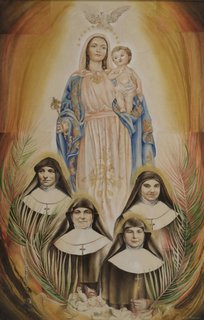
BLESSED AURORA LOPEZ GONZALEZ
BLESSED DARIA ANDIARENA SAGASETA
BLESSED AGUSTINA PEÑA RODRIGUEZ
Blessed Aurelia Arambarri Fuente
Mother Aurelia was born in Vitoria, Álava, Spain on October 23, 1866. She was baptized on the same day in the Parish of Saint Maria of Vitoria (the old Cathedral) and received the name Clementina Francisca. Her parents were fervent Catholics and raised their daughter in the faith.
Sister Aurelia was 20 years old when she entered the Congregation of the Servants of Mary. She was admitted by Mother Soledad Torres Acosta, the Foundress, and also received the Holy Habit from Mother Soledad’s hands on November 14, 1886. She made her first profession on December 18, 1887, and was then sent to Puerto Rico where she made her perpetual profession on December 18, 1894
By the time she was 38 years old, she was appointed Superior of the community of Guanajuato, Mexico, then later of Durango and Puebla, Mexico. It was there that she experienced the terrible Mexican Revolution. By August, 1916, she was transferred back to Spain as Superior of the communities of Mataró, Alcoy, Sarriá and Barbastro. Everywhere she lived and served as Superior, she always showed the same zeal and interest for the good of the Sisters. Extremelly prudent, her Sisters could always count on her trustworthy confidentiality.
In October, 1929, the Province of Madrid was established, and she was sent there as Provincial Councilor and Superior of the community of Pozuelo de Alarcón until 1934. By this time, she was suffering from progressive paralysis and was moved to the Infirmary of the Motherhouse in Madrid. For all who cared for her or visited her, she was a model of virtue: she never complained of her sufferings and always showed the same patience and conformity to God’s will. Everything was fine for her and she responded with gratitude for any and all services that were done for her.
In whatever circumstance she found herself, although extremely difficult, she would say: “It will be as God wishes. He knows that we are here.” She saw everything as coming from God’s hand, and in him she completely trusted, repeating over and over: “We belong to God; He will not let anything bad happen to us.”
When the Spanish Civil War began in July, 1936, the Motherhouse in Madrid was taken over, and the Sisters had to be dispersed among families that they knew. They had to be extremely watchful and had absolutely no communication with one another. Because of the danger the elderly Sisters faced, it was decided to send Mother Aurelia to the convent in Pozuelo de Alarcón where it was more peaceful; however, the plan of God was very different.
Mother Aurelia and three other Sisters were recognized as religious, and without denying at any time their state as a consecrated women, they were chosen to be martyred. It is very probable that Mother Aurelia died on the night of December 6-7, 1936 in Aravaca (Madrid).
Blessed Aurora Lopez Gonzalez
Sister Aurora was born in San Lorenzo, Madrid, Spain, on May 29, 1850. She was baptized on May 31 and received Justa as her baptismal name.
Her parents, José and Eusebia raised and educated Justa in the Catholic. Justa entered the Congregation as a Postulant on March 20, 1874 in El Escorial and later was transferred to the Novitiate at the Motherhouse in Madrid. She was vested in the Holy Habit on May 14, 1874.
She made her first profession on June 24, 1875 and professed perpetual vows on July 2, 1895 in Madrid. She was appointed as Superior of Arévalo in 1885 and returned to Madrid in 1893. She was also later transferred to and lived in the communities of El Escorial, Salamanca, Alcalá de Henares, Cabeza del Buey, Jaén, Ciudad Real and finally Pozuelo de Alarcón.
She was a contemporary of Mother Soledad, and her life faithfully reflected the simplicity, courage, goodness, and sober spirit of her Foundress. During her long religious life, she showed her love for the Congregation and sacrificed herself in the ministry to the sick; indeed she had great zeal and desire for the salvation of all those with whom she came into contact. She loved to share her experiences with the younger religious and encouraged these Sisters to wait patiently for God’s coming into the souls confided to their care.
Having a very energetic and hardworking character, she always gave herself tirelessly to the community in whatever way she could despite her advanced age. The Sisters who lived with her remember her faithfulness to her duty of ringing the rising bell in the morning. She was always the first to rise each day, no matter how early it was, and then she would wake up the Sisters by ringing the bell. She would be the first one in the Chapel and spent much time praying in the presence of the Blessed Sacrament.
She always had plenty of stories which she recounted with much delight and humor and brought much joy and happiness to the Sisters’ gatherings.
She unconditionally and generously accepted whatever the Lord had planned for her in her last months of life. Having to take off the Holy Habit caused bitter tears to run down her aging face which had spent long nights of dedicated service and vigilance watching over her sick brothers and sisters.
When the Spanish Civil War began in July, 1936, the Motherhouse in Madrid was taken over, and the Sisters had to be dispersed among families that they knew. They had to be extremely watchful and had absolutely no communication with one another.
Sister Aurora and three other Servants of Mary were recognized as religious and were chosen to be martyred. It is very probable that Sister Aurora died on the night of December 6-7, 1936 in Aravaca (Madrid).
Blessed Daria Andriarena Sagaseta
Sister Daría was born in Donamaría, Navarre, Spain, on April 5, 1879 and was baptized the following day in the parish of Our Lady of the Assumption. She received as her baptismal names Josefa Engracia, but she was informally known as Graciana.
Her parents, Nicolás and Francisca, taught their daughter the Catholic Faith and Christian values which were the center of their life.
At 23 years of age, Graciana entered the Congregation in the convent in San Sebastián on November 9, 1902, and a few days later moved to the Novitiate in Madrid. After professing her first vows on May 4, 1905, she was sent to the convent in Zaragoza where she carried out the apostolate of caring for the sick with much dedication for the next five years.
In March of 1910, she was sent to the convent in Ciudad Real for a brief amount of time. She finally returned to Madrid and there professed her perpetual vows on May 5, 1913.
It was not long before she became sick from a gastric ulcer. This condition made Sister Daría’s humility manifest as it seemed to her that all the alleviations, attention, and care given to her were too much for her.
In 1922, she was sent to the Novitiate of the Motherhouse with the duty of Auxiliary Sister to the Novice Director for the Coadjutor Sisters. Her charity toward the Novices was immeasurable, for she acted like a mother to them and sacrificed herself when they needed her. She was a true role model for the young Sisters who knew her. She remained in this charge for eight years, after which she was sent as Councilor and Secretary for the community in Pozuelo de Alarcón. Her admirable virtue was also visible in this community, and all were edified by her pleasant and religious behavior.
The Sisters saw the surrender of her life not as something casual and ordinary, but as the culmination and climax of the life that she had lived out until then. They frequently heard her say: “I desire the martyrdom of daily sacrifice and if God so wills it, also that of death, to die as a martyr for him.”
In 1936 she was detained by the revolutionaries along with Mother Aurelia and Sister Aurora. According to the family that took in Sister Daría, when she was the object of insults and humiliations because they suspected that they were Religious, she affirmed: “We are truly religious; you can do what you want to us, but I beg you not to do any harm to this family. When they saw that we did not have a house, they took us into their own home out of charity and authorized by the Committee of Pozuelo.
Sister Daría was chosen to be martyred which very likely happened during the night of December 6-7 in Arvaca (Madrid).
Blessed Augustina Pena Reodriguez
Sister Agustina was born in Ruanales, Cantabria on March 23, 1900. Her parents, Melitón and Agustina, with Christian love and zeal made sure that their daughter was brought up in the Catholic Faith. She was baptized two days later on March 25 in the Parish of the Triumph of the Holy Cross and received the name Mary Assumption.
Before too long, she experienced the pain of separation and hard work. Her mother died when she was still very young, and over time, an austere, laborious spirit along with attentiveness to others’ needs was forged in her.
God had indeed chosen and set her apart for himself alone. On December 14, 1924, she entered the Congregation as a Postulant in Tudela and eventually went on to the Novitiate in Madrid. She received the habit of a Coadjutor Sister on July 4, 1925 and her name was changed to Agustina in remembrance of her mother.
Those who lived with her during her Novitiate, describe her as “a person of uncommon virtue, of noble sentiments, and, though without formal education, very intelligent”.
On July 5, 1927, in Madrid, she professed her first vows and four days later was sent to the community in Pozuelo de Alarcón. She was to prove to be an immense support to the elderly and sick Sisters. She was of course dedicated to the housekeeping duties, and especially to the upkeep of the garden. She was always attentive and ready to serve the Sisters in whatever way they needed her.
As a woman of profound devotion and prayer, those who knew her, say that for Sister Agustina, everything became as a Chapel, and when she did have some spare time, she always would go before the Lord in the Blessed Sacrament to remain with him in profound recollection and prayer.
Her great charity was made manifest when Mother Aurelia, already incapacitated, was commended to her daily care. She considered this to be a sacred duty. She would attend to Mother’s needs even at night, getting up to see her each time Mother called. Never once did anyone hear a complaint from Sister Agustina.
In 1936 when the Sisters had to abandon the convent in Pozuelo de Alarcon, she was given refuge with three other Sisters by the same family, but the soldiers forced her to be separated from them. She joined another family that was fleeing to Rozas, and it was there that she was accused of being a Religious after having been seen praying. Her life of 36 years was crowned with martyrdom on December 5, 1936.
Prayer through their intercession
We bless you, Father, because in each period of history, you raise up in the Church witnesses of the faith, who cause your fidelity and love for mankind to shine forth. You chose Blessed Aurelia, Aurora, Daría and Agustina, through their lives of service to the sick, the suffering and their families, to be a reflection of your love that never abandons mankind. You made their weakness strong, and for love of you they gave witness of their faith, even to the shedding of their blood. We ask you to glorify your Servants and to grant us the graces we ask for through their intercession if this is for your greater honor and glory. Amen.
In conformity with the decrees of Pope Urban VIII, we declare that we do not intend in any way to precede the judgment of the Church’s authority. This prayer is not intended for public worship.
Venerable Soledad Sanjurjo Santos
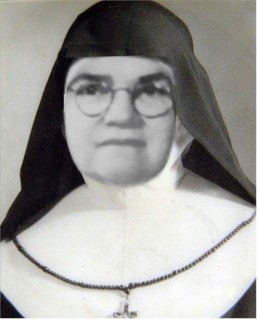 “Pearl of the Antilles”
(1892-1973)
On November 15, 1892 in Arecibo, Puerto Rico, Mother Soledad Sanjurjo Santos was born into this life. She was the last of six children of José Sanjurjo González, of Spanish origin, and María de la Palma Santos del Toro who was born in San Juan.
She was baptized on April 3, 1893, in what is today the Cathedral of Saint Phillip in Arecibo and given the name María Consuelo. She was barely six months old when her father died at the age of forty-five. The young widow did all she could to care for her children until succumbing to tuberculosis. She died on July 10, 1901 in San Juan at the age of thirty-eight.
Consequently, at the young age of nine years, María Consuelo could no longer depend on her parents’ support. When faced with having to provide her with an education, family members entrusted this delicate responsibility to a religious institution; together with her sister Antonia, she boarded in a school in Río Piedras called "La Protectora" that was run for orphan girls by the Servants of Mary, Ministers to the Sick. This is where María Consuelo spent her childhood and adolescence. Frequent contact with the Religious along with a soul that was open to spiritual things brought about in her the vocation to the consecrated life. She was admitted to the Institute as a postulant in this same community of Servants of Mary in Río Piedras on August 4, 1909.
Her time of Novitiate was spent in the Mother House of the Congregation in Madrid, Spain where she received the religious habit on May 31, 1911. On this day María Consuelo’s name was changed to María Soledad by which she would be known in the religious life. On June 1, 1913, she made her Temporary Profession and on December 17 was sent to Manzanillo, Cuba where she would spend the time of her third probation. She then professed Perpetual Vows in Santiago de Cuba on April 30, 1921.
All who dealt with her admired her profound spiritual life, prudence and keen intelligence, along with great simplicity and undeniable humility. After having carried out various responsibilities in the community, she was named Superior of the house in Matanzas, Cuba on August 18, 1939, and successively in Manzanillo and San Juan, Puerto Rico. Three year later on July 20, 1950, she was appointed Provincial Superior of the Antilles and established her residence in the Provincial Curia in La Habana. During this time period, she set out to “build a Novitiate for the young vocations that would come in the Antilles”. After having served two terms, she left this position and on March 19, 1959 became the Superior of the Community of San Juan, Puerto Rico.
Because of her zeal, the Institue grew with the foundations of the Communities in Santo Domingo, Santiago de los Caballeros and La Vega in the Dominican Republic. Communities were also established in Caguas and Aibonito. These Tabernacles were set up in the place of those she had seen closed in Cuba to her great sorrow.
Three years later and still in San Juan where the Provincial Curia of the Antilles had been moved because of the revolution in Cuba, Mother Soledad once again became the Provincial Superior on June 29, 1962. During this time, her health deteriorated due to a heart attack. In June of 1966 she completed her time as Provincial Superior and was sent to the community of San Juan where she would remain for the last seven years of her life: she accepted each day as a gift and simply offered what she was able to do. She was happy to do this unconditionally and selflessly carried out each task.
When she was reaching the culmination of her life journey, she wrote to Mother General who was asking for volunteers for a foundation in Cameroon: “Reverend Mother, I tell you in all sincerity that if I were a few years younger and had better use of my legs, I would offer myself wholeheartedly to go to Africa, but I must be conformed with the desire and with the offering of my prayers so the Lord will bless and help the Sisters who have the good fortune of going.”
She would continue with this same spirit until the moment of her death caused by acute pulmonary edema at 10:00 on the night of April 23, 1973. It was Easter Monday. She died at the age of eighty and sixty-two years of consecrated life.
As a Servant of Mary, Mother Soledad lived a Charism marked by service to the suffering; the self-donation required for this, if authentic, must be sealed with respect, concern, anonymity, and the simple gesture of serving Christ out of love, and in his name serving those who know the fragility of life.
Since she was a person of few words, we will never know through her personal account, the repercussion that suffering had in her life, but in her response to the difficult situations she had to confront throughout her life, we can discover a rich gold-mine of trust in God and of unconditional abandonment into his hands.
Enterprising and with great initiative, she knew how to live peacefully, always seeking the will of God in every circumstance. She saw difficulties as a time of waiting in order to set her time according to God’s clock. When beginning her projects, she provided all the neccessary means to reach the goal and would then pray and calmly wait for the time designated by God to arrive.
She did not seek to be the protagonist; rather, hidden with Christ in God, she tried to go unnoticed. Her presence sowed peace in the communities she visited and wherever there was discord.
By consistently living what she promised the Lord and by her attitude more than by her words, she was responsable for leading her Sisters and spoke firmly when she saw deviations from the essential elements of the consecrated life and from the genuineness of the charism. She was a valid referernce for the religious who dealt with her. Her way of being also marked the life of the lay people who knew her because she always took advantage of the opportunity to show them true christian values.
Because her life bore the stamp of evangelical simplicity, it has withstood the test of the passing of time and continues being valid, not only for the Servants of Mary of today, but for the believing faithful who see in the simple person of Mother Soledad Sanjurjo a valuable incentive to live gospel values and a christian reference for their own times.
PRAYER FOR THE INTERCESION OF VENERABLE SOLEDAD SANJURJO

HER WORDS:
“The Lord and His Most Holy Mother will give us the strength we so need at this time.”
“Our Lord God will provide; He is our Father and never abandons anyone.”
“Nothing gives more peace to the soul than complete surrender into the hands of God.”
“Let us earnestly pray to the Blessed Virgin Mary, our loving Mother, that she may always be our consolation and support in life’s struggles.”
“May the Virgin Mary cover you with her motherly mantle.”
“Never lose hope of becoming holy; with God’s grace all is possible, despite our misery.”
“It is not time yet. We must wait for our clock to be set according to God’s time. It will happen, but when God wants.”
“The Lord is waiting for you here. Open your heart to Him because He wants to enter. He will speak to you.”
“Everything for the love of God, and everything that is done for God is done well and out of love.”
“So many Tabernacles were closed when our Sisters left Cuba; in other new communities I would like as many Tabernacles to be set up again for the glory of God and the salvation of souls.”
“How glorious it is for a Servant of Mary to work where nobody sees her; but God sees her.”
“We come to the religious life to serve, following the example of Christ and the Virgin Mary.”
“My Jesus, I love you: forgiveness and mercy”. These were the last words she said, sealing her lips for ever.